Enterprise AI, without enterprise-wide AI training
Turn AI skills intono-prompt web apps
Your teams keep providing the business data they already know. Skiller turns it into governed AI results in minutes—not days—without asking every employee to learn prompts, models, or new AI tools.
No prompt training requiredPrivate company workspaceLocal project executionPermissioned and auditable
AIin the flow of work
One controlled pathfrom what people know to what the business can use
From business contextto a governed resultOne controlled path for repeatable knowledge work.
01 · See the product
Let the workflow explain the platform
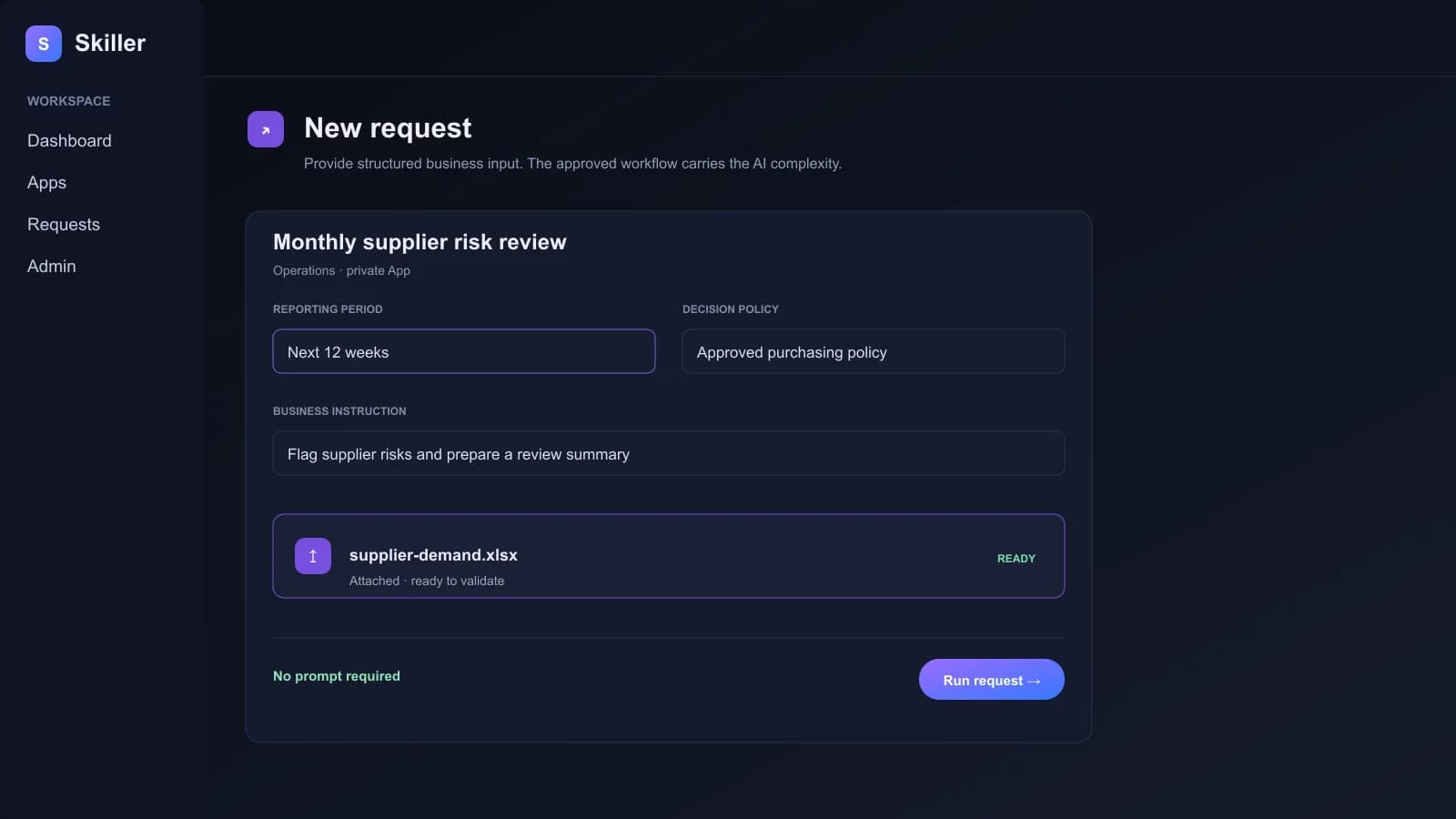
Start with the same sequence an enterprise user experiences: provide the input, let the approved path run, and receive the result with its record attached.
supplier-demand.xlsxAttached · 2.4 MB · ready to validate
No prompt required
Why this matters
People start with a familiar form, not a blank prompt box.
Step 1 of 5
02 · Why now
AI is availableAdoption is the problem
Published enterprise signals point to a common constraint: teams need useful AI inside the work they already do, without adding a new operator role to every desk.
88%
regular AI use
Organizations report using AI in at least one business function, but only about one-third say scaling has begun.
Skiller interpretationAvailability is no longer the main problem. Operationalization is.
The employee’s responsibility stays close to the work. The platform carries the complexity that must be repeatable, permissioned, and reviewable.
Your team providesThe business context
Skiller handlesThe AI path
Files, dates, criteria, and instructionsRequired-field and file validation
The business decision that needs supportApproved App, prompt, and skill configuration
Existing operational source dataPermission checks and deterministic request materialization
Review and final business judgmentRunner routing and local AI execution
Approval or follow-up actionStatus, logs, outputs, and downloadable files
04 · Business outcomes
Make the value legible to every stakeholder
COO / Operations
Shorten repetitive knowledge-work cycles from days to minutes.
CIO / IT
Keep approved tools, local context, access controls, and runtime ownership.
CFO
Release expensive staff capacity from recurring analysis and report preparation.
Department leaders
Package internal AI skills once and distribute them as controlled Apps.
05 · Inside the system
See what each part of Skiller owns
These are sanitized product surfaces from the working system. The labels around them explain the boundary; the images show the kind of control that already exists.
Sanitized product surfaceScene 01 / 05
Product UI illustration
Real interface patterns, sanitized for public explanation.
Employees provide normal fields, files, dates, and criteria. The business input is structured before AI execution begins.
The user’s job is to describe the work and attach the source material—not to design a prompt.
The original input, completion state, execution summary, output, files, timing, and provider evidence stay attached to one request.
A result is not a disappearing chat message. It is a reviewable work record.
A Runner discovers a local project and its skills, creates a private draft, and Web controls the form, prompt, Runner assignment, outputs, translations, and publication.
The capability can be distributed without handing every employee the project folder or the prompt behind it.
Web sees authenticated Runner health and assignment. Runners Manager supervises workstation-local profiles, while the Runner retains ownership of local project paths and execution.
Production knowledge stays where the approved project runs; the Web container coordinates the job and receives the result.
App access and privileged changes are enforced in backend paths and recorded for review, so teams can understand who changed what and which capability it affected.
Governance is part of the execution path, not a slide added after the workflow ships.
06 · Ownership boundary
Cloud coordinationLocal execution
Skiller does not ask you to copy every production project into a Web container. Each layer owns the part it can govern best.
Clear ownership boundary
Web coordinates the work. The Runner owns local execution. The output returns to the request.
Illustrative business case
Find capacity in repeatable work
Change one factor. Watch the annual hours and capacity move. Add another workflow when the first one makes the business case visible.
People × weekly runs × minutes saved ÷ 60 × 48 working weeks × hourly cost
Workflow portfolio1 workflow in the model
Start with one workflow, then see what changes.
Working hours released annually0Across the modeled workflows
Saved only in this page session and never sent to Skiller. Actual value depends on workflow volume, current cycle time, labor cost, implementation quality, and adoption.
07 · Find the first skills
Show us where AI stallsWe’ll map useful skills
Describe the company, the roles that do not see value in AI yet, and the recurring work they already understand. We’ll turn that context into practical Skiller App ideas and send them by email.
08 · Security and governance
Control the workflowKeep the project local
Skiller’s controls are concrete parts of the request and execution lifecycle—not unsupported compliance promises.
Backend-enforced permissions
Access is checked in APIs and execution paths, not only hidden in the interface.
Workspace separation
Users, Apps, Runners, requests, groups, files, and settings stay bound to their workspace.
Deterministic request record
The final execution prompt is materialized and stored when a request is submitted.
Authenticated local execution
Each Runner is workspace-bound and mapped to an owned workstation profile.
Controlled publication
App bundles arrive as private drafts, and model-generated bundle content is treated as untrusted.